Recipient of the 2025 Janet Wells Public Policy Leadership Award from the National Consumer Voice for Quality Long-Term Care.
Eilon has been working in the aging field his entire adult life, starting in 1994 as a nurse aide in a nursing home where his grandfather lived. HIs work, research, presentations, training programs, consultations, publications, volunteering, and data-driven advocacy focuses on improving the dignity, quality of care, quality of life, and safety of elders in general and individuals with dementia in the community and long-term care homes (such as nursing homes and assisted living residences).
He worked as a social worker in a long-term care home for low-income elders with dementia in the city of Jaffa Israel and over the years he educated and trained thousands direct care partners, interdisciplinary care teams, and managers in long-term care homes on various care-related issues pertaining to elders with dementia in the United States, Canada, and Israel.
He is frequently invited to give presentations and training programs to direct care partners and other care professionals (such as nurses, social workers, managers, and administrators) in long-term care homes and support groups as well as at various aging and dementia-related agencies. He also regularly give presentations (such as on prevention of distressing and harmful resident-to-resident interactions in dementia in long-term care homes) at professional and scientific conferences at the local, state, national, and international forums as well as at the Veterans Administration. A few years ago, he gave a presentation on this prevalent, concerning but largely hidden public health problem at the United Nations in New York City.
Eilon worked as a consultant in long-term care homes for people with dementia where he led a culture change journey.
He developed and enjoyed teaching an upper-level undergraduate course entitled Psychology of Older Adults with Memory-Loss at the Psychology Department of University of Massachusetts Boston, MA.
In his applied research over the past 18 years, he led studies and projects in long-term care homes on: fatal resident-to-resident incidents, injurious and deadly neglect, self-neglect, seriousness of mistreatment complaints (including abuse), residents’ fear of retaliation, staff fear of retaliation, theft of money and jewelry, theft of opioid pain medications, and social media abuse.
He regularly educates and trains family members and paid direct care partners and other care professionals in dementia-specific approaches, communication techniques, and personalized psychosocial strategies for prevention of behavioral expressions among elders with dementia, and development and implementation of culture change practices in long-term care homes and in the community.
Eilon has been greatly influenced by the pioneering and groundbreaking work of the late Professor Tom Kitwood (Bradford Dementia Group, UK) and have a special interest in innovative person-directed care models of such as the Habilitation Model of Care (Dr. Paul Raia), the Need-Driven Dementia Compromised Behavior Model, the Validation Method (Naomi Feil), and the Progressively-Lowered Stress Threshold Model.
He has always been passionate and committed to translating, disseminating, and implementing useful knowledge from research into practice and ensuring that those who need it the most – elders, people in early stages of dementia, their family care partners, paid direct care partners, care professionals, and policy makers – will have easy access to it when they need it.
While many applied researchers are tuned to the pressing needs of people with dementia at the “ground level,” there is still a large disconnect between academia/research and practice. The combination of Eilon’s personal experience with dementia in his family, his extensive professional experience working with and caring for this population, and his applied research experience places him in a unique position to serve as an invaluable resource for this population. It enables him to create a bridge between the two worlds. Dissemination and “translation” of useful knowledge from useful research to care practice has been very rewarding for him over the years.
As a Gerontologist and Dementia Behavior Specialist, trainer/educator, elder mistreatment researcher, author, data-driven care advocate, and elders’ human rights activist Eilon’s goal is to improve the dignity, quality of care, and safety of individuals living with dementia through evidence-based educational programs, person-directed psychosocial strategies, and support to this population and their family and paid (professional) care partners.
Both of Eilon’s grandmothers lived with dementia. While he didn’t care for them directly, he frequently saw during his visits how the cognitive disabilities caused by their brain disease impacted them and the entire family and what it took to support and care for them at home and then in different long-term care homes.
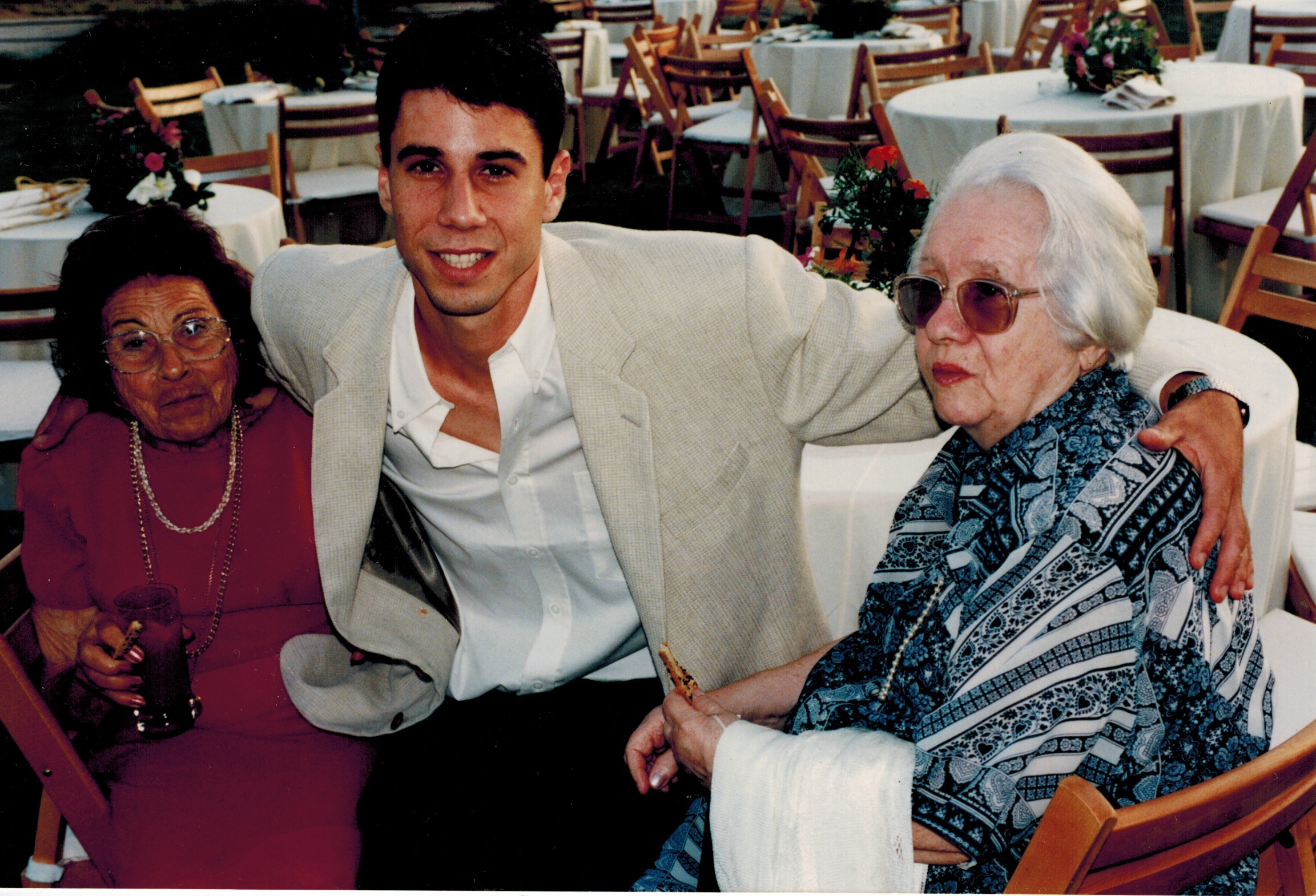
You can see here a picture from the days when Eilon’s grandmothers (Rivka Caspi on the left and Ester Bernard on the right) were independent and physically and cognitively healthy…and when Eilon was 25 years younger…
Eilon’s personal and professional experiences enable him to connect with people living with dementia and their family and paid care partners wherever they are with a deep understanding, sensitivity, and respect to their daily struggles, abilities, disabilities, preferences, and hopes.
He believes that the best teachers, trainers, and experts are…people living with dementia. They actually know what it means to live with a cognitive disability. Therefore, to provide person-directed care, we would be wise to listen to their wishes in the early stages of dementia and continue to listen and attend to their emotional needs and non-verbal language and the meaning underling their behavioral expressions at the later stages.
Eilon strongly believes that building and maintaining close trusting relationships, collaborations, and partnerships with people living with dementia (an “Authentic Partnership;” a term coined by Dr. Sherri Dupuis) is fundamental to enabling these individuals to live their life with dignity, to the fullest possible, and experience the highest practicable psychological well-being despite living with cognitive disabilities.
Whether you are a person living with dementia, a family member of a person with dementia, a care professional, or organization dedicated to caring for elders with dementia or to passing legislation aimed at protecting elders and those living with dementia, Eilon is looking forward to working closely with you.
You must be logged in to post a comment.